
Trade Marks Registry
Mumbai
4 states and UTsHead officeOur office
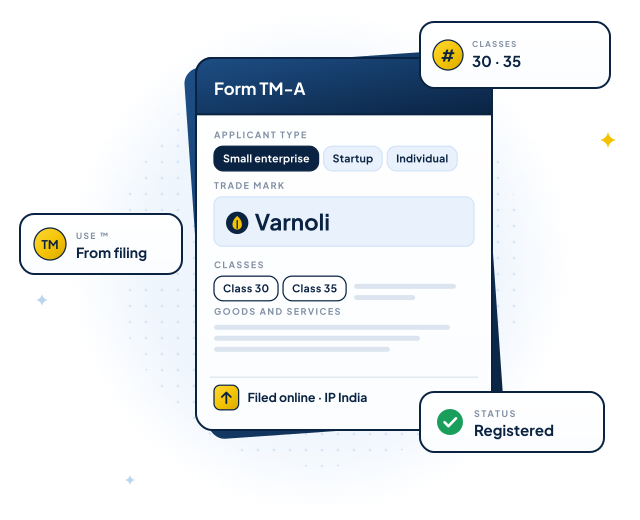
Trade Marks Act, 1999 · Form TM-A · Filed online with the Trade Marks Registry
Trademark registration gives you the exclusive right to a brand name, logo or slogan for your goods or services under the Trade Marks Act, 1999. You file Form TM-A with the Trade Marks Registry (IP India); the mark is examined, advertised in the Trade Marks Journal for a four-month opposition window, then registered. Without objection or opposition this commonly takes 6 to 12 months, and registration lasts 10 years from the application date, renewable indefinitely.
Five Trade Marks Registry offices
Mumbai is the head office. Our Vashi office is in Mumbai’s territory.
Which office handles youTrademark registration records you as the proprietor of a sign that distinguishes your goods or services from those of others, for the goods or services you list, across India. A trade mark can be a word, logo, slogan, shape, combination of colours or a sound, as long as it can be represented graphically (Section 2(1)(zb) of the Trade Marks Act, 1999).
Use alone gives some protection. An unregistered brand can be defended in a passing-off action, but you must prove goodwill, misrepresentation and damage every time. A registered proprietor can sue for infringement under Section 29 without first proving reputation, and the registration is prima facie evidence of validity (Section 31). Registration is also what customs recordal, marketplace brand-protection programmes, licences and investor due diligence ask for.
Four limits are worth knowing before you file:
Yes. Brand name registration in India is trademark registration of the name as a word mark. A word mark protects the name itself in any font, colour or style, so it is usually the first filing for a new business. Incorporating a company or LLP, a GST registration or a domain name does not create trademark rights: the Registrar of Companies checks company names, not brands in the market.
A name registers most easily when it is distinctive. Invented words and arbitrary words (an ordinary word with no link to the product) are the strongest. Suggestive names usually register. Names that describe the product, its quality, quantity or origin draw a Section 9 objection and need evidence that the public already sees them as your brand.
If you also use a logo, file the word mark first or alongside it. A logo registration protects the artwork as a whole and may not stop a competitor using your name in a different design. A tagline can be registered as a separate word mark when it identifies your business rather than praising the product.
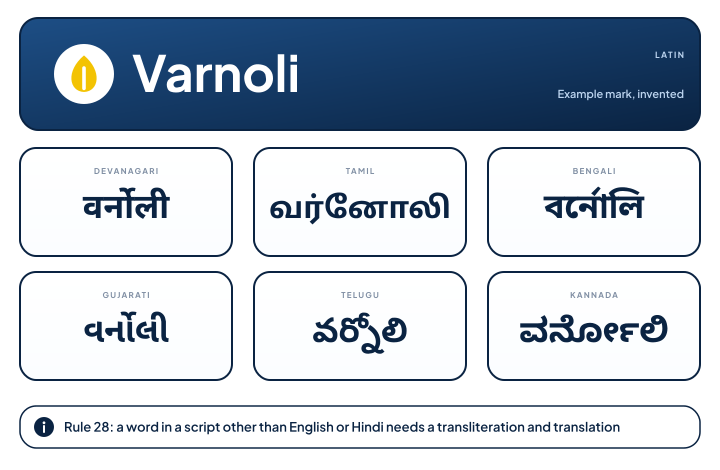
Rule 28, Trade Marks Rules, 2017
A mark with words or numbers in a script other than English or Hindi is filed with a transliteration and translation, stated in the application with the language named (rule 28, Trade Marks Rules, 2017). The examiner compares marks by sound and meaning across scripts, so search and file every version customers see.
The artwork shows Varnoli, an invented example name, in each script.
What else the application needs: documents for trademark registration.
The official fee is paid to the Trade Marks Registry for each class and is lower for individuals, startups and small enterprises. Our professional fee is separate and confirmed in writing before filing.
₹4,500per class · Form TM-A, e-filing
Individual or sole proprietor
Proof · Identity and address proof; the application is in the proprietor’s own name
Udyam-registered MSME, in any legal form
Proof · Udyam registration certificate, in the applicant’s own name
DPIIT-recognised startup
Proof · DPIIT recognition certificate
Rule 2, in short. Only an individual, a startup and a small enterprise pay the lower rate, as rule 2 of the Trade Marks Rules, 2017 defines them. A company, LLP or firm qualifies only as a DPIIT-recognised startup or with Udyam registration, and the certificate is filed with the application.
₹9,000per class · Form TM-A, e-filing
Partnership firm
Lower rate with Udyam registration
Proof · Partnership deed; Udyam certificate if claiming the lower rate
Private limited company or LLP
Lower rate if a DPIIT startup or Udyam-registered
Proof · Certificate of incorporation; Udyam or DPIIT certificate if claiming the lower rate
Trust or society
Proof · Constitution documents; power of attorney on Form TM-48
Foreign applicant
Lower rate for a foreign startup that files the Startup India declaration
Proof · Power of attorney on Form TM-48 and an address for service in India
Government fees from Trade Marks Rules, 2017, First Schedule (IP India), as checked on . Statutory fees only; the firm's professional fee is quoted separately in writing. Every fee and proof: trademark government fees.
| Government fee, e-filing | Individual, startup or small enterprise | All other applicants |
|---|---|---|
| Application for registration of a trade markForm TM-Aper class | ₹4,500 | ₹9,000 |
| Request for expedited examination of an applicationForm TM-Mper class, e-filing only | ₹20,000 | ₹40,000 |
| Notice of opposition, or counter-statementForm TM-Oper class | ₹2,700 | ₹2,700 |
| Renewal of registration (Section 25)Form TM-Rper class | ₹9,000 | ₹9,000 |
Government fees from Trade Marks Rules, 2017, First Schedule (IP India), as checked on . Statutory fees only; the firm's professional fee is quoted separately in writing.
The lower rate applies to individuals, DPIIT-recognised startups and small enterprises, on proof of status filed with the application. Paper filing costs more than e-filing. See all trademark fees or estimate a filing with the fee calculator.
The journey under the Trade Marks Act, 1999 and the Trade Marks Rules, 2017, with the periods the law fixes and whose part each stage is. Each stage links to the page or guide that explains it.
10 stages · Trade Marks Act, 1999 and Trade Marks Rules, 2017
Eight stages from first search to certificate. Times are typical rather than fixed by law, except where a statutory period is stated. The step-by-step process page covers each stage in more depth.
Before filing
We search IP India records for identical and similar marks in the relevant classes, including phonetic and visual matches, and give you a written risk note. A search is not compulsory, but it is the least costly way to avoid a Section 11 objection or an opposition later. See trademark search.
Before filing
Goods and services fall into 45 classes under the Nice Classification. We word the specification to cover what you sell and plan to sell, without claiming so widely that unused items become vulnerable to removal. See trademark classes.
Day 1
The application is filed with the statutory fee per class and IP India issues an application number at once. From then on you may use the ™ symbol. If the mark is already in use, the claimed date of first use is supported by an affidavit and evidence.
Weeks 1 to 4
The Registry checks the filing details and codes the figurative elements of a logo under the Vienna Classification. No action is needed unless a formality defect is raised. The status then reads Formalities Chk Pass; our guide to trademark status meanings decodes every label.
Usually within a few months
An examiner tests the mark against the absolute grounds in Section 9 (distinctiveness, descriptiveness, deceptive or prohibited matter) and the relative grounds in Section 11 (earlier conflicting marks). The result is acceptance or an examination report listing objections. While the file waits, the status reads Marked for Exam.
Within one month of the report
A written reply is due within one month of receiving the examination report, or the Registrar may treat the application as abandoned (Rule 33). If the reply does not persuade the examiner, a show cause hearing is fixed. See objection reply.
Four months from the Journal
The accepted mark is advertised in the Trade Marks Journal and the status reads Accepted & Advertised. Anyone may oppose on Form TM-O within four months of the Journal date (Rule 42), and the applicant then has two months to file a counter-statement. See opposition.
After the opposition window
If no opposition is filed, or an opposition is decided in your favour, the mark is entered on the register and the certificate issues. Registration takes effect from the application date (Section 23) and lasts 10 years.
Most applications need very little paper. What matters is that the applicant, the mark and the goods or services are stated correctly, because they are hard to change later.
The name in plain text. Protects the word itself in any font or colour, and is usually the first filing.
A logo, with or without words. Protects the artwork as filed; a separate word mark protects the name.
A tagline that identifies your business, filed as a word mark. Purely laudatory slogans are refused.
The shape of goods or packaging, if distinctive and not dictated by function or the nature of the goods (Section 9(3)).
A sound filed as an MP3 of up to 30 seconds with a graphical representation such as notation (Rule 26(5)).
Used by members of an association (Sections 61 to 68), or to certify origin, material or quality (Sections 69 to 78).
Signals that you claim the mark. It has no statutory meaning, so it can be used before and after filing.
Only for a registered mark, and only for the registered goods or services. Misuse attracts a monetary penalty under Section 107.
A service-mark convention from the United States, not defined in Indian law. ™ is the usual choice in India.
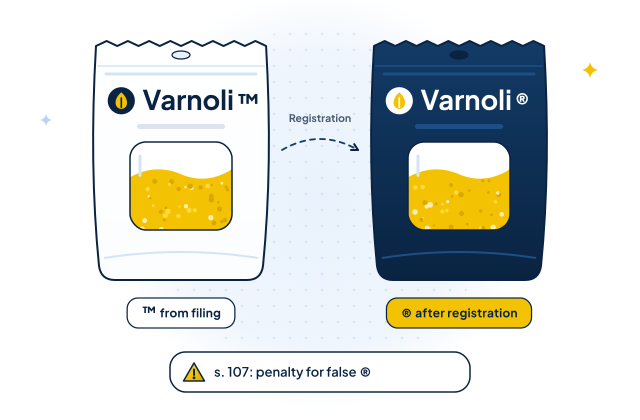
The same pack before and after registration. ™ can go on it from the day you file. ® only once the mark is registered, and only for the registered goods or services: representing an unregistered mark as registered attracts a monetary penalty under Section 107. Our guide to TM vs R symbols covers the details.
Without objection or opposition, a mark commonly registers in 6 to 12 months from filing. Most of that time is spent waiting on the Registry. Each objection, hearing or opposition adds months, which is why the search and class choice at the start matter most.
| Stage | Typical time | Status on IP India |
|---|---|---|
| Filing | Same day | New Application |
| Formalities and Vienna codification | 1 to 4 weeks | Send to Vienna CodificationFormalities Chk Pass |
| Examination | Usually within a few months | Marked for ExamObjectedAccepted |
| Reply and hearing, if objected | Reply within 1 month; hearing later | Ready for Show Cause Hearing |
| Journal advertisement and opposition window | 4 months from the Journal date | Advertised bef accAccepted & AdvertisedOpposed |
| Registration | After the window closes | Registered |
Status names are shown as IP India displays them and can change. "Advertised bef acc" means the mark was advertised before acceptance, which Section 20(1) allows in some cases. Expedited examination on Form TM-M brings examination forward; it does not shorten the four-month opposition window.
Most refusals come from two sections of the Act. A search and a frank look at the name before filing avoid the majority of them.
| Ground | Section | What it catches |
|---|---|---|
| Not distinctive | 9(1)(a) | Common words, plain shapes or ordinary surnames that do not point to one business |
| Descriptive | 9(1)(b) | Words describing the kind, quality, quantity, purpose, value or geographical origin of the goods or services |
| Customary in the trade | 9(1)(c) | Terms that have become the ordinary word for the product in current language or trade practice |
| Deceptive or prohibited | 9(2) | Marks likely to deceive or cause confusion, hurt religious sentiment, contain obscene matter, or use protected names and emblems |
| Conflict with an earlier mark | 11 | An identical or similar mark for identical or similar goods or services where confusion is likely, or a well-known mark |
| Bad faith | 11(10) | Copying a mark you know belongs to someone else; it can lead to refusal or later cancellation |
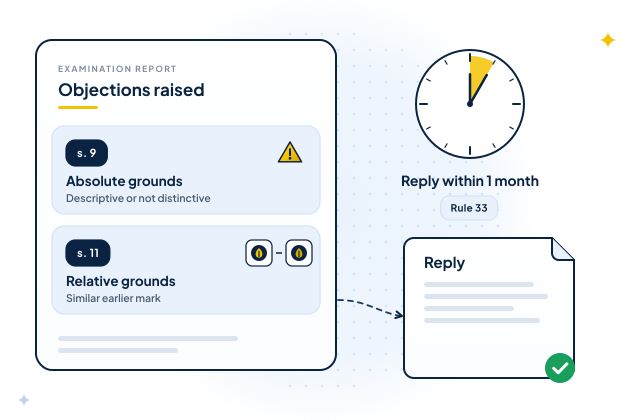
Section 9 and Section 11 objections reach you in an examination report. A written reply is due within one month of receiving it, or the Registrar may treat the application as abandoned (Rule 33). See objection reply.
Jurisdiction follows the principal place of business in India of the applicant, or of the first-named applicant in a joint application. An applicant with no place of business in India is handled by the office covering its address for service in India. Filing is online for every office; jurisdiction decides which office examines your file and where hearings and oppositions are heard.
Trade Marks Registry
4 states and UTsHead officeOur office
Trade Marks Registry
9 states and UTs
Trade Marks Registry
13 states and UTs
Trade Marks Registry
7 states and UTs
Trade Marks Registry
3 states and UTs
Based on the Registry’s notified territorial jurisdiction, as set out in our registry jurisdiction guide. Confirm the current notification on IP India before relying on it in a dispute.
| Office | States and union territories |
|---|---|
| Mumbai (head office) | Maharashtra, Goa, Madhya Pradesh, Chhattisgarh |
| Delhi | Delhi, Haryana, Punjab, Himachal Pradesh, Jammu and Kashmir, Ladakh, Uttar Pradesh, Uttarakhand, Chandigarh |
| Kolkata | West Bengal, Bihar, Jharkhand, Odisha, Assam, Arunachal Pradesh, Manipur, Meghalaya, Mizoram, Nagaland, Sikkim, Tripura, Andaman and Nicobar Islands |
| Chennai | Tamil Nadu, Kerala, Karnataka, Andhra Pradesh, Telangana, Puducherry, Lakshadweep |
| Ahmedabad | Gujarat, Rajasthan, Dadra and Nagar Haveli and Daman and Diu |
Yes. Form TM-A is filed online on the IP India portal, and e-filing carries a lower government fee than paper filing. The application number issues the same day. Online filing does not change the examination, advertisement and opposition stages that follow.
Yes, and you can mark it ™. Use builds goodwill that supports a passing-off action and gives prior-user protection under Section 34. The risk is that an earlier mark already exists, so search before you invest in packaging and signage.
File in the classes covering what you sell now and expect to sell in the next few years. The government fee is charged per class. A clothing label usually files in Class 25, and adds Class 35 if it also offers retail or online store services under the brand.
Any person claiming to be the proprietor of the mark (Section 18): an individual, joint owners, a partnership firm, a company, an LLP, a trust or society, a government body or a foreign entity. A sole proprietor files in their own name, trading as the business name.
Yes. A registration covers the whole of India, whichever Registry office handled it. The office only decides where the application is examined and where hearings and oppositions take place.
The Registrar may treat the application as abandoned (Rule 33). Depending on the facts, a request to set the abandonment aside can sometimes be made, but there is no right to it. Diarise the one-month date the day the report arrives.
Usually the name first, as a word mark, because it protects the name in any design. A logo registration protects the artwork as filed. Businesses that rely on both file both, in the same classes.
You can request expedited examination on Form TM-M, filed online with a higher fee. It brings examination and any hearing forward. It does not shorten the four-month opposition window after advertisement.
No. Copyright protects the logo as artwork against copying; a trademark protects it as a badge of origin for your goods or services, including against similar marks. Many businesses hold both. See copyright for artwork and logos.
Each city page names the Trade Marks Registry that handles it, local industries and their usual classes, and the areas we serve.
Trade Marks Registry
Mumbai
Covers Maharashtra, Goa, Madhya Pradesh and Chhattisgarh
Trade Marks Registry
Delhi
Covers Delhi, Haryana, Punjab and more
Trade Marks Registry
Chennai
Covers Tamil Nadu, Karnataka, Kerala and more