Accepted and Advertised: What Happens Next for Your Trademark
What Accepted and Advertised means, how the four-month opposition window works, and how long it takes to reach Registered.
- Written by
- Advocate, intellectual property
- Reviewed by
- Registered Trade Marks Agent
- Updated
- · 6 min read

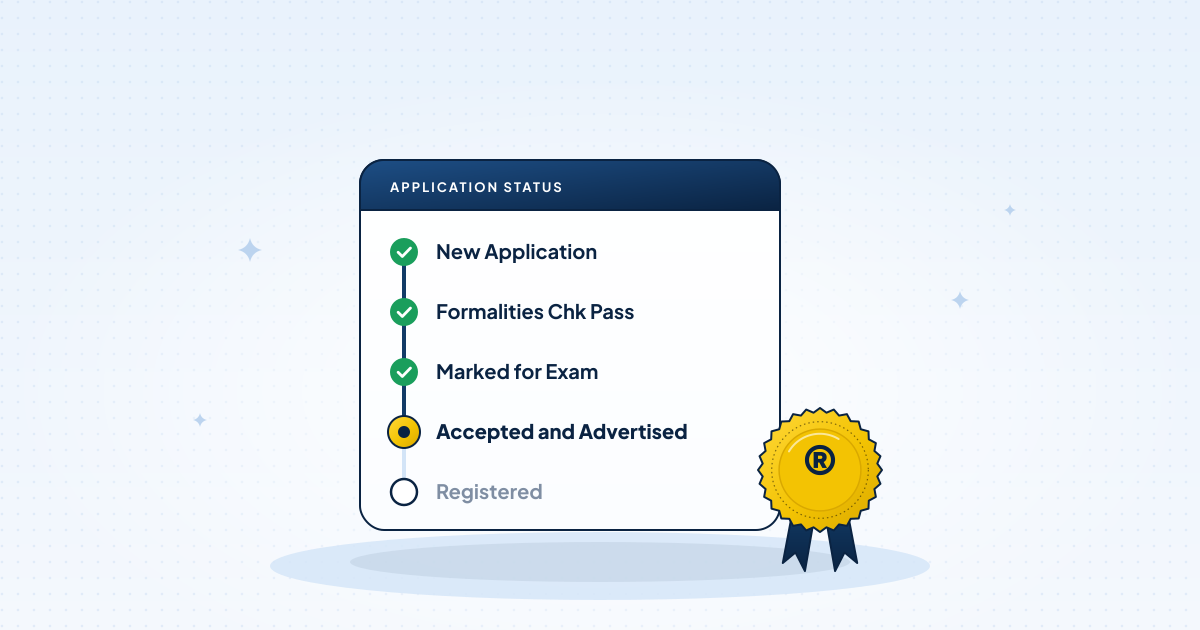
Accepted & Advertised means the examiner has accepted your trademark and it is published in the Trade Marks Journal. For four months from the Journal’s publication anyone may oppose it on Form TM-O (section 21; rule 42). If nobody does, the mark proceeds to registration and the certificate issues. No action is needed unless an opposition is filed.
- Reviewed by
- Registered Trade Marks Agent
- Last updated
On this page · 8 sections
What does Accepted and Advertised mean?
Two things have happened. First, the Registrar has accepted the application under section 18 of the Trade Marks Act, 1999, either straight after examination or after your reply or a hearing overcame the objections. Second, the application has been advertised in the Trade Marks Journal under section 20(1), so that the public can see it and object.
The Journal is published online by IP India; the Registry’s 2022-23 annual report says a new issue appears every Monday. Your mark’s entry shows the application number, the mark, the class, the goods or services, the applicant and any conditions or disclaimers.
Acceptance is a strong step, but it is not registration yet. The mark is still an application, you still use ™ rather than ®, and acceptance can in limited cases be withdrawn before registration under section 19, for example if it was accepted in error.
How does the four-month opposition window work?
The fixed periods once a mark is advertised. Section 21(1) gives three months, extendable by up to one month; rule 42 sets a single four-month period for filing Form TM-O.
| Step | Period | Source |
|---|---|---|
| Notice of opposition (Form TM-O) | Within four months of the Journal’s publication | Section 21(1); rule 42 |
| Copy of the notice served on you | Ordinarily within three months of filing, by the Registry | Rule 42 |
| Your counter-statement | Within two months of receiving the notice, or the application is deemed abandoned | Section 21(2); rule 44 |
| Opponent’s evidence | Within two months of the counter-statement | Rule 45 |
| Your evidence | Within two months of the opponent’s evidence | Rule 46 |
| Evidence in reply | Within one month | Rule 47 |
| Opposition hearing | At least one month after the first hearing notice | Rule 50 |
Oppositions are common: IP India’s 2024-25 annual report records 82,915 notices of opposition filed in that year. Our opposition service covers both filing and defending one.
A worked example: from the Journal to the certificate
Illustrative dates for a mark advertised in a Journal published on Monday, 5 January 2026, with no opposition filed.
5 Jan 2026
Journal published
The status reads Accepted & Advertised. The four-month window opens.
By 5 May 2026
Opposition window closes
Four months from publication (rule 42). Anyone wishing to oppose must have filed Form TM-O by then.
After the window
Registration
With no opposition on the file, the Registrar registers the mark under section 23(1). The certificate is issued online on Form RG-2 (rule 56).
From the filing date
Ten-year term
The registration counts from the application date, not the certificate date (section 23), and lasts ten years from it (section 25).
How long from Accepted and Advertised to Registered?
At least four months, because the opposition window must close first. After that it depends on whether anyone opposed:
- No opposition. Registration follows the close of the window. IP India’s 2022-23 annual report says automating the issue of registration certificates reduced the pendency at that stage to less than one month.
- Opposition filed. The case runs through counter-statement, evidence and a hearing, each with its own fixed period, before the Registrar decides. That usually takes far longer than the unopposed path, and no reliable average is published.
If four months have passed and the status has not changed, check the documents on the e-register for a notice of opposition before assuming the file is simply waiting. A notice can be filed on the last day and take time to be served.
Accepted and Advertised vs Advertised before Accepted
The second status is rarer. Under the proviso to section 20(1) the Registrar may advertise an application before accepting it.
| Accepted & Advertised | Advertised before Accepted | |
|---|---|---|
| Accepted yet? | Yes, under section 18 | No; the decision on acceptance comes later |
| Why advertised | The usual step after acceptance (section 20(1)) | Section 9(1) and section 11(1) or (2) issues, or exceptional circumstances (proviso to section 20(1)) |
| Opposition window | Four months from the Journal | Four months from the Journal |
| What follows | Registration if unopposed | The Registrar decides acceptance after the opposition period |
| Your action | Watch for an opposition | Watch for an opposition and any further hearing |
How do you know if someone has opposed your trademark?
The Registry serves a copy of the notice of opposition on you, ordinarily within three months of its filing (rule 42), by email to the address on the application. The status on the e-register then changes to Opposed, and the notice appears among the documents on the file.
Because service can lag behind filing, do three things while the window is open and for a few months after it closes:
- keep the email address on the application monitored, and have it updated on the record if it changes;
- check the documents on the e-register, not only the status line;
- note the Journal number and date shown on the file, so the four-month period can be counted precisely.
An agent on record receives the Registry’s correspondence for you and diaries the counter-statement date from the day the notice arrives.
What should you do if your trademark is opposed?
Diary the counter-statement date at once. The two months run from the day you receive the notice of opposition, and missing them means the application is deemed abandoned under section 21(2), with no hearing on the merits.
A good counter-statement answers each ground the opponent pleads and sets out your own use and reputation. Many oppositions settle, for example by narrowing the goods or a co-existence agreement, but settle from a position of strength: file on time first, negotiate after. Our trademark opposition service defends applications through to the opposition hearing.
If you are the one who wants to object to someone else’s advertised mark, the same four-month window is your deadline.
Accepted and Advertised: questions
Is Accepted and Advertised the same as registered?
No. It means the mark is accepted and published for opposition. It becomes registered only after the four-month window closes without opposition, or an opposition is decided in your favour.
How long does it take from Accepted and Advertised to registration?
At least four months, for the opposition window. Unopposed marks are then registered and the certificate issued online; an opposition adds the counter-statement, evidence and hearing stages.
Can I use ® once my mark is Accepted and Advertised?
No. Keep using ™ until the status is Registered. Using ® earlier attracts a monetary penalty under section 107.
Where can I see my trademark in the Journal?
On IP India’s website, in the Trade Marks Journal for the date shown on your file. The e-register lists the Journal number for your application.
Can the Registry withdraw acceptance after advertisement?
In limited cases, before registration, under section 19: for example if the mark was accepted in error. You are given notice and the chance of a hearing before acceptance is withdrawn.
What happens if nobody opposes my trademark?
The Registrar registers it under section 23(1) and issues the certificate. Registration dates back to your filing date and lasts ten years, renewable on Form TM-R.