How the Madrid Protocol Works: MM2(E), WIPO Checks and Refusals (2026)
The basic mark, Form MM2(E), WIPO examination, refusals and central attack, explained in order.
- Written by
- Registered Trade Marks Agent
- Reviewed by
- Advocate, intellectual property
- Updated
- · 7 min read
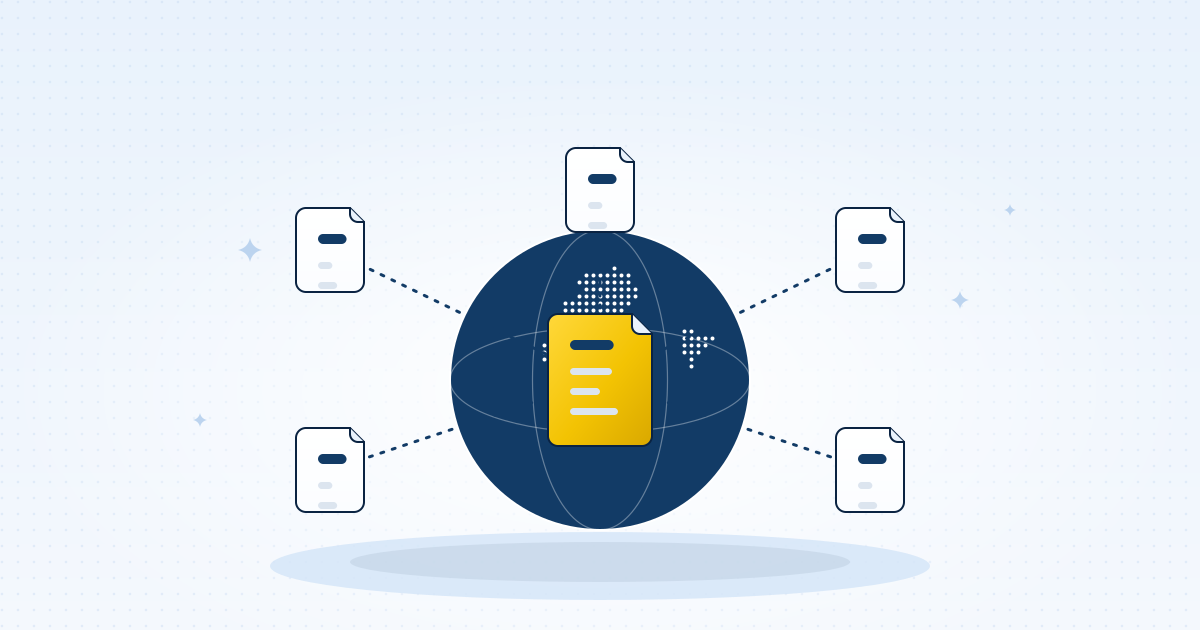
From India, a Madrid Protocol application is filed online on Form MM2(E) through the Trade Marks Registry, based on an Indian application or registration for the same mark. The Registry certifies it and sends it to WIPO, which registers it and notifies each country you chose. Each country then has 12 or 18 months to refuse protection; if it does not, your mark is protected there, and the whole portfolio is renewed and updated at WIPO.
- Reviewed by
- Advocate, intellectual property
- Last updated
On this page · 7 sections
What do you need before filing a Madrid application?
This guide explains how the system works from the Indian side; our Madrid Protocol filing from India page covers the service itself. Before filing you need three things: eligibility, a basic mark, and a country list you have checked.
Eligibility. India can be your office of origin if you are an Indian national, are domiciled in India, or have a real and effective industrial or commercial establishment in India.
A basic mark. The international application must be based on an Indian trademark application or registration in the same name. The mark must be identical, and the goods and services in the international application must be the same as or narrower than those in the basic mark. A basic application filed on the same day is acceptable.
A checked country list. Madrid lets you designate any member of the Madrid System, more than 130 countries, but it does not tell you whether your mark is free in them. A clearance search in the main target markets, especially the USA, China and the EU, avoids paying for designations that will be refused or opposed. Countries outside the Madrid System, such as Hong Kong, Taiwan, South Africa and Nigeria, need direct filings.
How does a Madrid application from India proceed, step by step?
Step 1
Prepare Form MM2(E)
Applicant details matching the basic mark, the mark itself, the goods and services by class, the countries designated, and any priority claim. For the USA, a declaration of intention to use (Form MM18) is attached.
Step 2
File through IP India
The application is filed in the Madrid module of IP India’s comprehensive e-filing system, with the handling fee, and the WIPO fees calculated in Swiss francs.
Step 3
Certification by the Registry
The Trade Marks Registry checks that the international application corresponds to the basic mark, certifies it and transmits it to WIPO. Received at WIPO within two months, it keeps the Indian filing date.
Step 4
WIPO formal examination
WIPO checks formalities, fees and classification. Irregularities, often vague terms, are notified and must be remedied within three months.
Step 5
Registration and notification
WIPO records the international registration, publishes it in the WIPO Gazette, sends you the certificate and notifies each designated country.
Steps 6–7
Examination in each country
Each office examines under its own law. A provisional refusal is answered locally within the period stated; if there is none, or it is overcome, a statement of grant of protection follows.
What is central attack?
Five years of dependency on the Indian mark
For five years from the international registration date, protection abroad depends on the Indian basic mark. If the Indian application is refused or withdrawn, or the registration is cancelled or limited, during that time, WIPO cancels the international registration to the same extent in every country. The owner can then transform each lost designation into a national application within three months, keeping the original date, at the cost of national filings.
What must be managed after registration?
One of Madrid’s main advantages is central management. These are the events to diarise.
| Event | Where it is handled | When |
|---|---|---|
| Provisional refusal from a country | Locally, through an agent in that country | Within the period in the refusal notice |
| Adding countries (subsequent designation) | WIPO, Form MM4, directly or through the Registry | Any time while the registration is in force |
| Change of owner | WIPO, Form MM5 | When an assignment takes place |
| Change of name or address | WIPO, one request for all countries | When the change takes place |
| End of dependency | — | 5 years from the international registration date |
| Use requirements | Locally (for example, the US declaration of use) | As each country requires |
| Renewal | WIPO, one renewal for all countries | Every 10 years |
WIPO forms and fees are on the Madrid System pages. The WIPO fee calculator gives the official fees for any combination of countries and classes.
Is the Madrid route right for every Indian brand?
It suits most Indian businesses that need protection in three or more Madrid countries and have a stable Indian mark. It is less suitable where:
- The Indian base is weak. A mark likely to face objections or opposition in India puts every designation at risk for five years. Direct filings avoid that link.
- One market matters most. For a single key country, a direct filing can be tailored to local practice from the start.
- The mark differs abroad. Madrid requires the same mark as the basic mark. A different spelling, transliteration or logo for a market needs a direct filing.
- The country is outside Madrid. Direct filing is the only option there.
Our Madrid Protocol filing service and the international trademark overview compare the routes for your list of countries.
Why do WIPO irregularity letters happen?
Most are about wording and classification
WIPO checks that each term is clear and in the right class. Vague terms such as "accessories", or goods placed in the wrong class, lead to an irregularity notice with three months to respond. Drafting the list in terms accepted by WIPO’s Madrid Goods and Services Manager, and by the strictest designated office, avoids most of them.
Questions about filing under the Madrid Protocol from India
Can I use a pending Indian application as the basic mark?
Yes. A pending application is enough. The risk is central attack: if the Indian application fails within five years, the international registration falls to the same extent.
Can I file in a different name from the Indian mark?
No. The applicant must be the same as the owner of the basic mark. If ownership has changed, record the change in India first.
Can the logo be in colour abroad if it is black and white in India?
The international mark must be the same as the basic mark. A colour claim abroad is possible only if the basic mark is in the same colours or claims them.
How are WIPO fees worked out?
A basic fee, plus a complementary fee per designated country or an individual fee set by that country, some of which charge per class. Fees are in Swiss francs. IP India adds a handling fee.
What happens if a country refuses protection?
The refusal is provisional. You respond in that country, usually through a local agent, within the time it allows. Protection in other countries is not affected.
Can I add countries later?
Yes, by a subsequent designation at any time while the registration is in force. The new countries are protected from the date of the subsequent designation, not the original date.
How long does protection last under a Madrid registration?
Ten years from the international registration date, renewable at WIPO for further ten-year periods with a single renewal covering all designated countries.
Do I need a separate agent in each country?
Not at filing. A local agent is needed only when an office issues a provisional refusal, a third party opposes, or a country requires local steps such as the US declaration of use.