EU and UK Trademarks After Brexit: Do You Need Both?
Why the EU mark stopped at the Channel, what became of older marks, and how to file in both markets now.
- Written by
- Registered Trade Marks Agent
- Reviewed by
- Advocate, intellectual property
- Updated
- · 6 min read
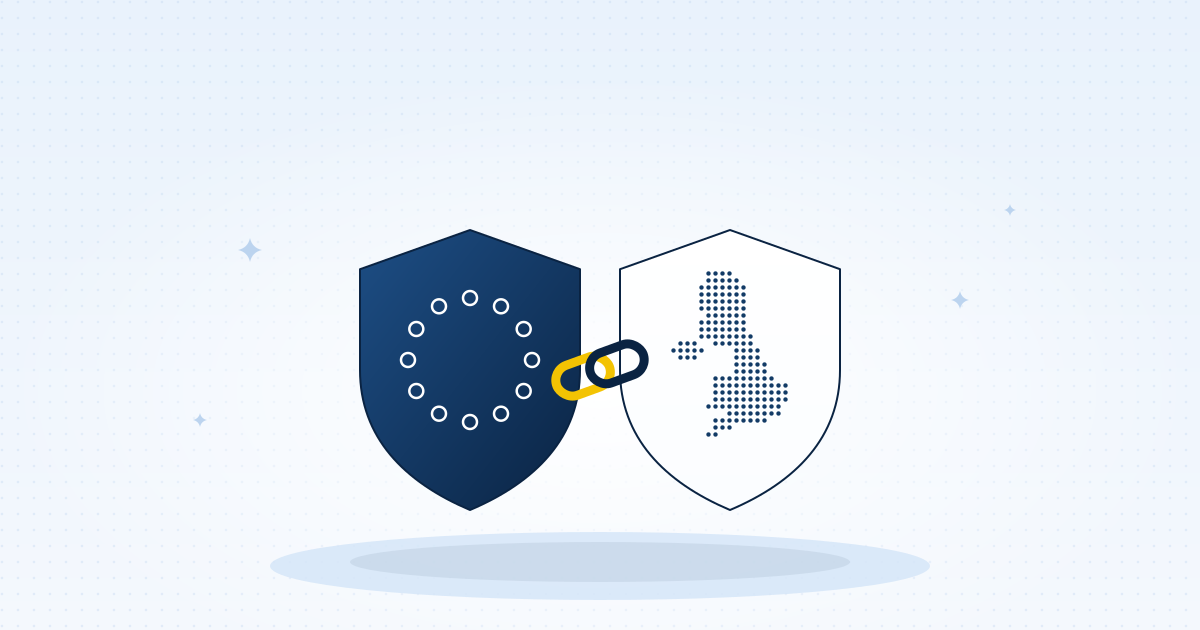
Yes, if you sell in both markets. Since 1 January 2021 an EU trade mark from EUIPO covers the 27 EU member states only, and the UK needs its own registration from the UKIPO, either filed directly or by designating the UK through Madrid. EU marks registered before 2021 were cloned into comparable UK marks, which are now separate rights with their own renewals.
- Reviewed by
- Advocate, intellectual property
- Last updated
On this page · 6 sections
What changed for trademarks when the UK left the EU?
Until the end of 2020, an EU trade mark covered the United Kingdom as one of the member states. When the transition period ended on 31 December 2020, the EU mark stopped having effect in the UK. The UK put three measures in place:
- Comparable UK marks. Every EU trade mark registered on 31 December 2020 was automatically cloned into a UK registration with the same filing and priority dates, at no cost to the owner. The UKIPO calls these comparable trade marks.
- Pending EU applications. Owners of EU applications pending on that date had nine months, until 30 September 2021, to refile in the UK and keep the EU dates. That window has closed.
- Madrid designations of the EU. International registrations designating the EU were given equivalent UK protection, recorded as UK designations.
Since then the two systems have run separately. A mark filed at EUIPO today has no effect in the UK, and a UK filing has no effect in the EU.
How do EU and UK trade marks compare today?
Both systems are similar in structure; the practical differences are in territory, representation and procedure.
| EU trade mark | UK trade mark | |
|---|---|---|
| Office | EUIPO, Alicante | UKIPO, Newport |
| Territory | 27 EU member states | England, Wales, Scotland and Northern Ireland |
| Earlier marks in examination | Search report only; refusal needs an opposition | Notified to the applicant; refusal needs an opposition |
| Opposition period | 3 months from publication | 2 months, extendable to 3 |
| Representation for non-residents | Professional representative in the EEA for most steps | Address for service in the UK, Gibraltar or the Channel Islands |
| Use requirement | Genuine use in the EU within 5 years of registration | Genuine use in the UK within 5 years of registration |
| Term | 10 years, renewable | 10 years, renewable |
| Through Madrid | Designate the EU | Designate the UK |
How should an Indian brand file in the EU and the UK now?
Treat them as two markets with two filings, planned together.
File both within six months of your Indian application. Both the EU and the UK accept a Paris Convention priority claim from India, so filings made within six months keep the Indian date. Our pages on EU trade mark registration and UK trade mark registration set out each office’s process.
Choose direct or Madrid as a pair. If India is your home office and the EU and UK are part of a wider list, one Madrid application designating both is efficient. If Europe is your main market, direct filings at EUIPO and the UKIPO keep both rights independent of your Indian mark.
Search both registers. A clear EU search does not clear the UK, and the reverse. Comparable UK marks created in 2021 sit on the UK register under their original EU dates, so older rights can surface in UK searches.
Use one specification. Draft the goods and services once in terms both offices accept. Differences between the lists later make enforcement and licensing harder.
Plan representation. EUIPO requires an EEA representative for most steps after filing; the UKIPO requires a UK address for service. UK attorneys can no longer act before EUIPO for non-EEA clients, so most owners appoint one adviser to coordinate both, as we do.
What should owners of older EU marks check?
If your EU mark was registered before 2021, you hold two rights now. A short audit avoids losing the UK one.
- Find the comparable UK mark. Its UK number is derived from the EU number; check it on the UKIPO register.
- Diarise both renewals. The EU mark renews at EUIPO and the comparable mark at the UKIPO, on their own dates and with separate fees.
- Record changes twice. Assignments, licences and changes of address must be recorded at both offices.
- Check use. Use in the UK before 2021 can support the comparable mark for that period; after that, each right needs use in its own territory.
- Review watch services. Watching the EU register no longer covers the UK. Set up both.
What about Switzerland, Norway and the rest of Europe?
They need their own protection as well. The EU trade mark covers the 27 EU member states only. Switzerland, Norway, Iceland, Turkey, Serbia and other non-EU European countries each have their own trademark offices, and most of them can be designated through the Madrid System in the same application that designates the EU and the UK.
Brexit also left a quieter problem in contracts. Licences, distribution agreements and co-existence agreements signed before 2021 often define the territory as "the European Union". Read literally today, that excludes the UK. If you rely on such an agreement, check the territory clause and, where needed, agree an amendment that names the UK expressly.
The same applies to brand guidelines, packaging and marketplace listings that refer to an EU registration as the basis for rights in the UK. After 2020, the UK right is the comparable UK mark or a UK filing, and that is the registration number to quote.
Questions about EU and UK trade marks after Brexit
Does Northern Ireland follow the EU or the UK for trademarks?
A UK trade mark covers Northern Ireland. An EU trade mark filed after 2020 does not cover any part of the UK.
I had an EU application pending in 2020 and did not refile in the UK. Can I still claim the old date?
No. The nine-month refiling window closed on 30 September 2021. A UK application filed now takes today’s date.
Is a comparable UK mark weaker than a normal UK registration?
No. It is a full UK registration with the dates of the original EU mark, and it can be renewed, assigned, licensed and enforced like any other.
Can one Madrid application cover both the EU and the UK?
Yes. A Madrid application filed through India can designate the European Union and the United Kingdom separately, each examined by its own office.
Do I need to use the mark in every EU country?
No. The EU test is genuine use in the EU as a whole, judged on the market and the goods. The UK test is genuine use in the UK.
Are EU and UK fees charged per class?
Both offices charge a basic fee that covers the first class and additional fees for further classes. Check current amounts on each office’s fee page before filing.
Can an Indian company hold both rights in one name?
Yes. The same Indian company can own the EU trade mark and the UK registration, and should, so that licensing and enforcement stay simple. Record any later change of owner at both offices.