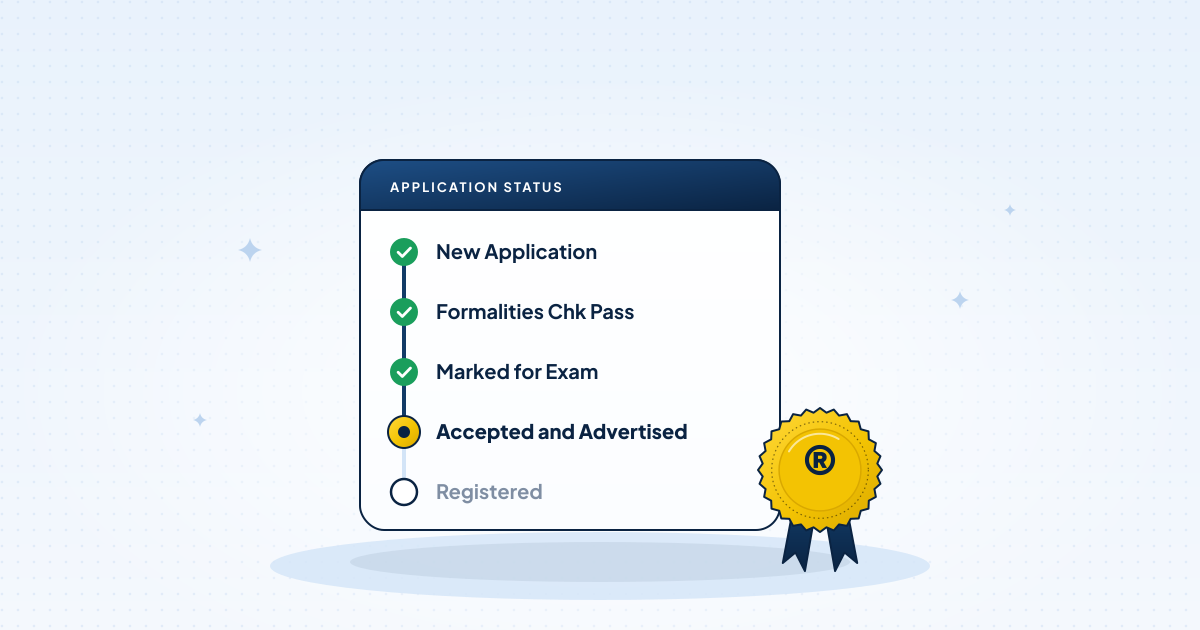
Marked for Exam: What It Means for Your Trademark
What Marked for Exam means, what the examiner checks, the possible outcomes, and what to prepare while you wait.
- Written by
- Advocate, intellectual property
- Reviewed by
- Registered Trade Marks Agent
- Updated
- · 6 min read

Marked for Exam means your trademark application has passed the formalities check and is allotted to, or queued for, an examiner at the Trade Marks Registry. No action is needed. The examiner will either accept the mark, which leads to advertisement in the Journal, or issue an examination report with objections, which you must answer within one month.
- Reviewed by
- Registered Trade Marks Agent
- Last updated
On this page · 7 sections
What does Marked for Exam mean on a trademark application?
It means the application has reached the examination stage. The file has cleared the formalities check and, for a logo, Vienna codification, and is now allotted for examination under section 18 of the Trade Marks Act, 1999.
IP India’s draft manual of practice describes how this works: applications are allotted to examiners automatically, strictly in the order of the date and time they were filed, in lots. So Marked for Exam can mean either that an examiner already has your file or that it is in the next lots to be allotted. The e-register does not show which.
Nothing is due from you at this status. The useful thing to do is prepare for the possible outcomes, described below.
Marked for Exam meaning in Hindi
हिंदी में: Marked for Exam का अर्थ है कि आपका ट्रेडमार्क आवेदन जाँच (examination) के लिए परीक्षक को भेज दिया गया है या कतार में है। अभी कोई कार्रवाई ज़रूरी नहीं है। जाँच के बाद या तो मार्क स्वीकार होगा, या आपत्ति (examination report) आएगी जिसका जवाब एक महीने में देना होता है।
What does the trademark examiner check?
Examination is the first look at the mark itself, not just the paperwork.
| Question | Law | What it means in practice |
|---|---|---|
| Is the mark distinctive? | Section 9(1)(a) | A mark must be capable of telling your goods apart from others’. Plain words for the product, or common surnames alone, are often objected to. |
| Does it describe the goods or services? | Section 9(1)(b) | Words for kind, quality, purpose or origin, such as "Fresh" for food or a city name, draw objections. |
| Is it customary in the trade? | Section 9(1)(c) | Terms already common in the trade cannot be owned by one trader. |
| Is it deceptive, offensive or prohibited? | Section 9(2) | Marks that may deceive or cause confusion, hurt religious sentiment, or are prohibited by law are refused. |
| Is there an earlier conflicting mark? | Section 11 | The examiner searches the register for identical or similar marks for the same or similar goods (rule 33(1)). |
| Are the formal details complete? | Trade Marks Rules, 2017 | Points missed earlier, such as a translation or a clearer specification, can be raised in the same report. |
Our guide to section 9 and section 11 objections explains each ground in detail.
What happens after Marked for Exam?
| Outcome | Status you will see | What you do |
|---|---|---|
| Accepted without objection | Accepted & Advertised | Nothing; watch the four-month opposition window |
| Objections raised | Objected (an examination report is on the file) | Reply within one month of receiving the report (rule 33(4)) |
| Reply not accepted | A show cause hearing is listed | Attend the trademark hearing, usually by video |
| Advertised before acceptance | Advertised before Accepted | Wait for the opposition period and the decision on acceptance |
How long does Marked for Exam take?
It depends on the examination queue, and the time changes with the Registry’s workload. IP India does not publish a current average for this stage, so be wary of any precise number.
Two things are fixed by law:
- Expedited examination. If you file a request on Form TM-M with the prescribed fee, rule 34 says the application is ordinarily examined within three months of the request. Any applicant may ask, once the application number has issued, and the Registrar can limit the number of requests by notice.
- Your reply period. When the report comes, the one-month reply period runs from the day you receive it, not from when you notice the status change. Our objection reply service drafts the reply within that month. The Registry emails reports to the address on the application, and publishes them on the file.
A long wait at Marked for Exam does not make an objection more likely, and the mark’s rights are not on hold: once registered, it counts from the filing date (section 23).
What if the examination report is missed?
The one-month reply period under rule 33(4) runs from receipt of the report, and the report is emailed to the address on the application. If no reply arrives, IP India’s draft manual describes a further notice under section 132 giving one more month to remedy the default; only after that is an abandonment order made.
That second notice is a safety net, not a plan. It goes to the same email address as the report, so a mailbox nobody reads misses both. Once the application is treated as abandoned, the realistic routes are a request to the Registrar to review the order, if the default was not your fault, or a fresh application with a later filing date.
If your file has been Marked for Exam for a while, check the documents on the e-register now and then, not only the status line.
What should you prepare while the application is Marked for Exam?
An objection answered well the first time often avoids a hearing. These are the materials a reply usually draws on.
- Evidence of use. Dated invoices, packaging, website captures and advertising that show the mark in use.
- Sales and spend figures. Year-wise turnover and promotion spend under the mark, if you rely on acquired distinctiveness.
- The story of the name. Why it was coined and what it means, if the examiner may call it descriptive.
- Differences from close marks. Notes on how your goods, trade channels and customers differ from those of any similar mark you know of.
- A working email. The address on the application must be monitored so the report is seen the day it issues.
- A decision on expediting. If a launch or a marketplace listing depends on progress, decide early whether to request expedited examination.
Marked for Exam: questions
Is Marked for Exam the same as Objected?
No. Marked for Exam means the application is waiting for, or with, the examiner. Objected means the examiner has issued a report raising objections. Many applications go from Marked for Exam straight to Accepted & Advertised.
My trademark has been Marked for Exam for a long time. Is something wrong?
Usually not; it reflects the examination queue. Check the documents on the e-register for any report you may have missed, and consider expedited examination if timing matters.
Can I speed up a trademark that is Marked for Exam?
Yes, if it has not yet been examined. File Form TM-M for expedited examination with the prescribed fee. Under rule 34 it is then ordinarily examined within three months of the request.
Will I be told when the examination is done?
Yes. The examination report or acceptance appears on the file, and the Registry emails the report to the address on the application. An agent on record also tracks the file for you.
Can I sell under the mark while it is Marked for Exam?
Yes, with the ™ symbol. Pending applications give no right to sue for infringement, but use under the mark builds the evidence that helps at examination and against later copiers.