PCT Deadlines and Costs from India: 12, 30 and 31 Months (2026)
The 12, 30 and 31-month PCT deadlines from India, the decisions at each one, and when the official fees and other costs fall.
- Written by
- Advocate, intellectual property
- Reviewed by
- Registered Patent Agent
- Updated
- · 7 min read

A PCT application from India is filed within 12 months of the Indian priority date, usually with the Indian Patent Office as receiving office. An international search report arrives at about 16 months, the application is published at 18 months, and you decide where to seek patents at the national phase, 30 months from priority in most countries and 31 months in India and at the EPO. Most costs fall at the national phase, country by country.
- Reviewed by
- Registered Patent Agent
- Last updated
On this page · 7 sections
Why do Indian applicants use the PCT?
This guide sets out the PCT deadlines and what each stage costs. For the filing itself, see our PCT patent application from India service.
The PCT buys time and information. Without it, you must file separately in every country within 12 months of your Indian application, paying national fees, translations and local attorneys at a stage when the market, the product and the funding are often still uncertain. With one PCT application, you keep more than 150 countries open until 30 or 31 months from priority and receive a search report and written opinion on patentability before committing to that spend.
The PCT does not grant patents. It is a single filing procedure followed by national or regional examination. A favourable written opinion helps, and some offices offer faster examination under Patent Prosecution Highway agreements, but each office decides for itself.
What are the steps and decisions in a PCT application?
Month 0
File the priority application in India
A provisional or complete application. If you are resident in India, this also starts the six-week period under section 39.
By month 12
Choose the receiving office and file
Indian applicants usually file with the Indian Patent Office (RO/IN). Filing with WIPO (RO/IB) as a first filing needs a foreign filing licence first. File the complete specification in India by the same date if you started with a provisional.
At filing
Choose the search authority
The Indian Patent Office has been an International Searching Authority since 2013 and usually costs less; an EPO search can suit applicants focused on Europe.
About month 16
Read the search report and written opinion
Decide whether to amend the claims under Article 19, within two months of the report or 16 months from priority, whichever is later.
By month 22
Decide on preliminary examination
An optional demand under Chapter II lets you amend and argue with an examiner before national phase, and receive a preliminary report on patentability.
By month 30/31
Enter the national phase
Choose countries, prepare translations and instruct local attorneys. Missing the date usually ends protection in that country.
How do I work out the dates for my invention?
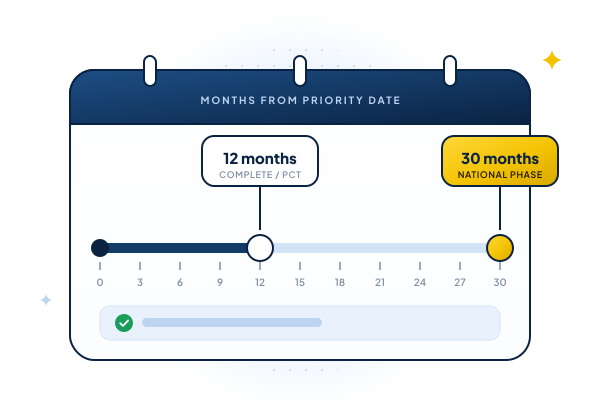
From one priority date: complete specification, convention and PCT, examination request and national phase.
Calculate deadlinesWhat does a PCT application cost, and when?
The PCT moves most of the cost to month 30/31. Official fees are set by WIPO and each office and change from time to time.
| Stage | Official fees | Other costs |
|---|---|---|
| Month 12: filing | Transmittal fee (receiving office), international filing fee (WIPO), search fee (ISA) | Drafting or adapting the specification; agent fees |
| Month 16–22: optional steps | Preliminary examination and handling fees if a demand is filed | Amendments and arguments |
| Month 30/31: national phase | National or regional filing fees in each country; examination fees in some | Translations; local attorney fees in each country |
| After national phase | Examination fees and annual renewal fees in each country | Responses to examination reports; grant and validation costs |
Current amounts, and reductions for electronic filing and certain applicants, are in WIPO’s PCT fee tables. We prepare a written budget by stage before filing.
How do you choose countries at the national phase?
Choose the countries where a patent will change someone’s behaviour within the patent term. Four questions narrow the list:
- Where will you sell? Markets with meaningful revenue in the next ten years.
- Where could competitors make or sell copies? Manufacturing hubs matter even if you do not sell there.
- Where can you enforce? A patent you cannot afford or cannot practically enforce has limited value.
- What do investors, licensees or acquirers expect? For many technology companies, the USA and Europe are expected as a minimum.
A common Indian applicant’s set is India, the USA and the European Patent Office, with China, Japan or Korea added for manufacturing-heavy fields. Pharmaceuticals and agrochemicals often go wider. Budget for every country through to grant, not only the entry fee.
What mistakes should Indian applicants avoid?
Each of these has cost applicants a country, a priority date or an Indian application.
- Filing after 12 months. A PCT filed late cannot claim the Indian priority date. Restoration of priority is possible only in narrow cases, and not every office accepts it.
- Adding new matter without noticing. Content in the PCT that was not in the Indian application has the later PCT date, not the priority date.
- Filing at WIPO without section 39 clearance. A first filing with RO/IB by an Indian resident needs the six-week wait or Form 25 permission.
- Forgetting Form 3 in India. Indian applicants must tell the Indian Patent Office about corresponding foreign applications, including PCT national phases, on Form 3.
- Treating 30/31 months as flexible. Late national phase entry is possible in some countries with fees, but not in all. Diary the earliest date.
- Cheap translations. Translation errors can narrow or invalidate claims. Use qualified patent translators for each language.
Questions about the PCT process from India
Can a PCT application be my first filing, without an Indian application?
Yes, if filed with the Indian Patent Office as receiving office. The PCT then sets the priority date, and India can be entered as a designated state at the national phase.
Do I enter India at the national phase if I already filed in India?
Not necessarily. If your priority application is a complete Indian application that proceeds to grant, you may not need an Indian national phase. If the Indian application was only a provisional that lapsed, India can be entered through the PCT within 31 months.
What is the difference between Article 19 and Article 34 amendments?
Article 19 amendments change the claims only and are filed after the search report. Article 34 amendments can change the description, claims and drawings and are made during Chapter II preliminary examination.
Is the international search report binding on national offices?
No. Offices take it into account but examine independently. A positive opinion can support faster examination under some Patent Prosecution Highway programmes.
When is the PCT application published?
WIPO publishes it promptly after 18 months from the priority date, together with the search report if available. It can be published earlier on request.
How do I work out my PCT deadlines?
Every PCT deadline runs from the earliest priority date. Our patent deadline calculator lists them, with the legal basis for each.
Can I stop a PCT application from being published?
Yes, by withdrawing it before the technical preparations for international publication are complete, shortly before 18 months from priority. Withdrawal ends the application, so it is used mainly when no country will be pursued.
Does the PCT extend the life of a patent?
No. In most countries the patent term is 20 years from the international filing date. The PCT delays national costs, not the end of the term.
Can I add new subject matter to a PCT application?
No. Amendments must stay within the disclosure as filed. Improvements made after filing need a new application, which can itself claim priority from a new Indian filing.